What to Check Before Buying WPC Artificial Wood Slats
Summary
A summary of what you need to know before buying WPC artificial wood slats, including checking actual coverage width, choosing for interior or exterior applications, board structure, installation systems, framing spacing, and expansion allowances, plus methods for calculating vertical and horizontal quantities to control budgets.
Key takeaways
- Calculating the number of boards must use the actual coverage width, not the total width of the product board.
- You must choose the type of WPC slats that matches the application; outdoor applications require outdoor grades that resist sun and moisture and leave expansion allowances.
- Budget estimation should consider the total system cost, including framing, fasteners, finishing profiles, and labor, rather than just the price per board.
- Orders should include a 5-15% allowance for cutting waste depending on project complexity, and consider keeping 1-2 spare boards for future color shade continuity.
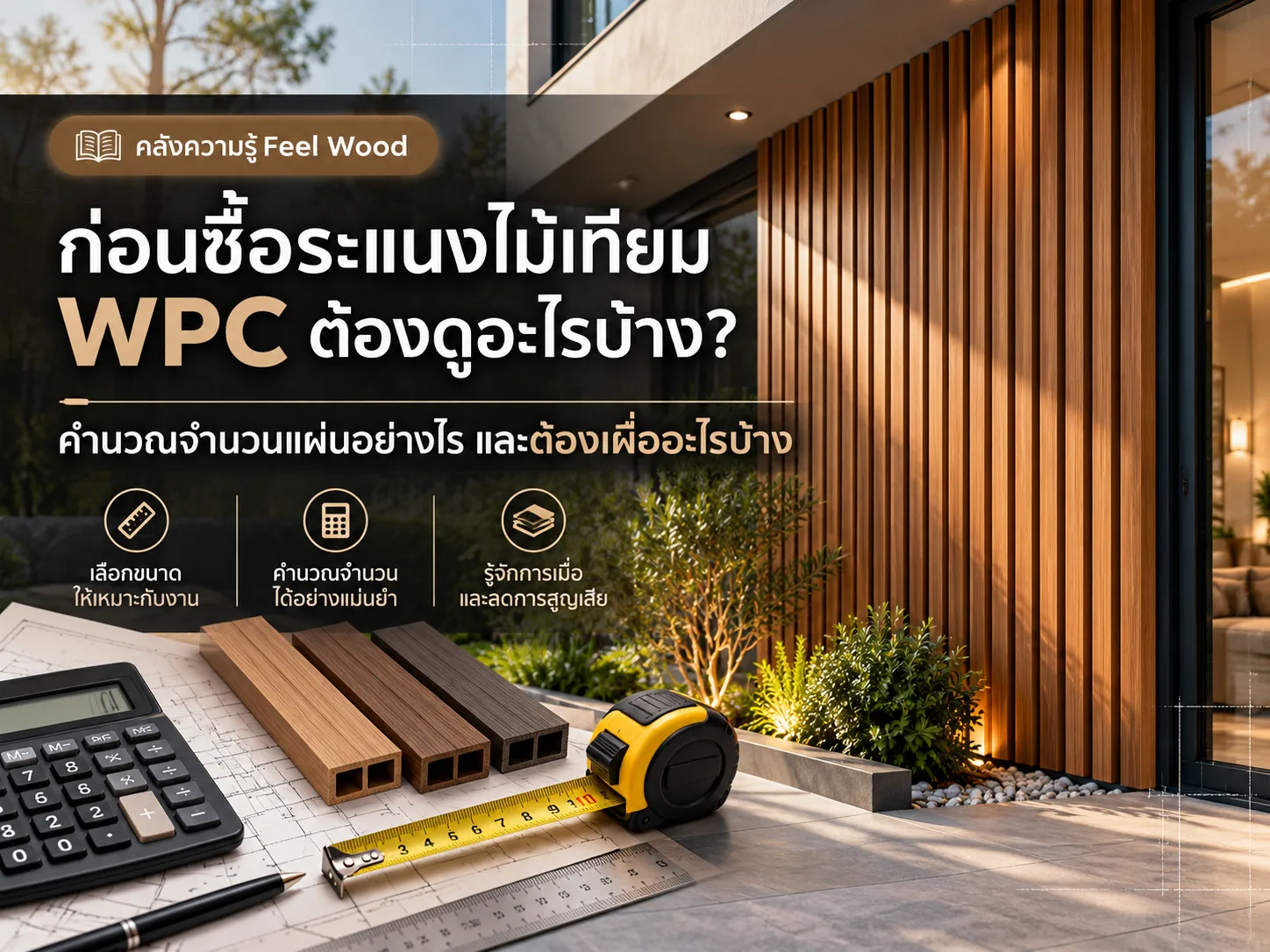
WPC artificial wood slats are a popular decorative material for both interior and exterior applications because they provide a natural wood-like atmosphere, are easy to maintain, and come in a variety of styles. However, before deciding to buy, you should not only consider the color, pattern, or price per board, as factors affecting your budget and actual work quality also include the actual coverage width of the board, installation system, support structure, material allowances, and installation orientation.
1. Check the Actual Coverage Width, Not Just the Board Size
The first thing to check is the dimensions of the slats, which include width, thickness, length, and the Coverage Width. This is very important, especially for tongue-and-groove or overlapping artificial wood slats and wall panels.
For example, a board may have an actual width of 219 mm, but when connected to the next board, the actual wall-covering area may be only 200 mm. If you use the total width figure for calculations, the material quantity can be off by several boards, especially for large area projects.
2. Choose WPC to Suit the Application Area
Each model of artificial wood slats has different structures and properties, so you must consider where they will be installed, such as interior walls, ceilings, exterior walls, fences, or sunshade slats (facades) in areas directly exposed to sunlight and rain.
For exterior work, you should choose products specified for outdoor use, paying attention to sun resistance, moisture resistance, color fading, and warranty conditions. Do not use interior slats outdoors, as their lifespan and material behavior differ significantly.
3. Look at the Board Structure: Hollow, Solid, and Coated Surfaces
WPC slats are available in hollow, solid, and exterior-coated surface variants, such as Co-Extrusion, which helps increase protection against stains, moisture, or color fading. Your choice should not strictly favor solid over hollow boards, but rather match the requirements of the specific application and the manufacturer's specified system.
4. Check the Installation System Before Buying
Each model has different installation methods, such as screwing through the board, using hidden clips, specialized locks, starting profiles, finishing profiles, edge covers, and corner accessories. These directly affect costs, so you should compare the total cost of the entire system after installation rather than just looking at the price per board.
5. Calculate the Cost of the Underlying Support Structure
Most artificial wood slats must be fixed to a support structure, such as steel frames, galvanized steel, or aluminum, installed at the spacing specified by the manufacturer. If the support frame is spaced too far apart, the boards may warp, sag, or fail to secure properly. Always ask the seller for the frame spacing to accurately estimate the number of frames, fixing points, and labor costs.
6. Allow for Expansion and Contraction Distances of WPC
WPC expands and contracts with temperature, especially in exterior applications. Do not install boards too tightly against walls or other materials. You must leave gaps at the ends and joints according to the product manual to prevent board warping, buckling, or deformed joints.
How to Calculate the Quantity of WPC Artificial Wood Slats
Calculating the number of boards depends on the installation direction:
Calculation Method for Vertical Installation
Use the formula: Number of boards = Area width ÷ Actual coverage width
Example: A wall width of 4.00 meters, height of 2.80 meters, using slats with a length of 2.90 meters and an actual coverage width of 0.15 meters. Calculated as 4.00 ÷ 0.15 = 26.67 boards, which must be rounded up to a minimum of 27 boards (one board perfectly covers the height).
Calculation Method for Horizontal Installation
You must first find the number of rows along the height by taking the area height ÷ actual coverage width, e.g., 2.80 ÷ 0.15 = 18.67, rounded to 19 rows. Then, multiply the number of rows by the wall width to find the total length (19 × 4.00 = 76 meters) and divide by the board length (76 ÷ 2.90 = 26.21 boards, or a minimum of 27 boards). However, horizontal work often involves joints and cutoffs, so a cutting layout should also be planned.
Material Quantity to Allow Extra
Do not order products that exactly match the actual area because there will be end cuts, corner fittings, and offcuts. Guidelines for allowances are as follows:
- Straight walls, simple shapes, few cuts: allow about 5%
- Walls with doors, windows, or corners: allow about 7–10%
- Multiple cutting locations or pattern layouts: allow about 10–15%
- Complex work with diagonal angles or many details: may allow more than 15%
Additionally, you should consider purchasing 1–2 backup boards for projects requiring color shade consistency to support future repairs.
Why You Should Not Calculate Solely from Square Meters
Dividing the square meter area by the area per board can lead to inaccurate quantities because wall shapes, board lengths, installation directions, and joints create offcuts that cannot be reused. Calculating from the actual coverage width, board length, installation orientation, and cutting plan yields more accurate results.
Additional Budget Items to Account For
In addition to the slat boards, you should budget for other parts of the system, including steel or aluminum frames, screws, fastening clips, wall anchors, starter profiles, finishing profiles, corner accessories, rust-proofing agents, as well as installation and detail-cutting labor costs.
Checklist Before Ordering WPC Artificial Wood Slats
- Width and height dimensions of the area
- Installation direction (vertical or horizontal)
- Length of the slat boards
- Actual coverage width of the product
- Application location (interior or exterior)
- Support structure spacing according to the manual
- Required installation systems and fastening accessories
- Necessity of finishing profiles and corner accessories
- Percentage allowance for cutting scrap
- Number of backup boards for repair work
Frequently asked questions
Why shouldn't you calculate the number of WPC slats solely from the square meter area?
Because wall shapes, board lengths, installation directions, and joint locations create cut pieces that cannot all be reused. Calculating from the actual coverage width, board length, and installation orientation provides more accurate results.
What is the actual coverage width of WPC slats?
It is the width of the board portion that actually covers the wall area after installation or interlocking with the adjacent board, which is usually less than the actual width of the product itself.
What percentage of artificial wood slats should be allowed extra when ordering?
Allow about 5% for straight walls with few cuts; allow about 7-10% for areas with doors, windows, or corners; allow about 10-15% for multiple cut locations or patterned layouts; and allow more than 15% for complex work with diagonal angles.
Are there any special precautions for installing WPC slats outdoors?
You must choose models specified by the manufacturer for outdoor use, featuring sun and moisture resistance, and leave end-joint gaps to accommodate material expansion and contraction due to temperature changes, preventing board warping or buckling.